Pages

About Burklee Farm

We are drystock farmers (sheep and beef) on 1200 acres (500 ha) in West Waikato, New Zealand. We have owned the property in an equity partnership since February 2008.

Get hold of us: malcolmnsally@wnation.net.nz

Sunday, 14 July 2013

Sharing some NZ farmlife with others


As you may have gathered reading some of our historic blogs, we have a tendancy to have a number of foreigners coming to stay.  This year we have had 4.  Although it is great to have foreigners here and share in our story and life, and hear about theirs, we would also welcome NZers to take part!

In February we had Priscillia from Montreal.  Main tasks while she was here was to do a bit of spring cleaning in the house which was well overdue and to do some child care, entertaining Alice after school, but I am not sure whether it was the other way around, and some farm stuff.  The things we did included:


Priscillia and her helper Alice feeding Mal Time Capsules
 (Zinc Bullets for Facial Eczema protection)


Blackberry picking ... we all managed to fill our containers up but
 Alice ate most of hers!


Priscillia had a go at crutching some lambs.


Then we spent a day at Raglan beach enjoying the sand and surf.
Then some pre-tup ewe drenching ...


And putting them away, note we were in February, and yes
it was dry!
 
Then we had Thomas from France.  We did a bit of sheep work (first time for Thomas) and lots of feeding out as we were in the throws of the drought and we put lime on a chunk of the farm, using the neighbours strip
Weighing lambs - Thomas got the hang of it
reasonably well.
Thomas having a go at drenching ... bit of hard
work!


Did lots of feeding out, with Thomas loading the trailers most
mornings.  Near the end he was left to feed out to one or two
mobs.  This is the R2 mobs of heifers being fed.


The fertiliser plane being loaded with lime

Dumping its load.
Just recently we had Chris-Ann and Shaun from Toronto.  We had the local cluster schools Arts Festival.  Te Akau did a Pacific Theme where they sung, danced and played the ukelale and doing really well at it.  Links to their performance are http://www.youtube.com/channel/UCLaZv35jsUoEsUYvwJuco9g?feature=mhee.  Here you can see the dances and also go through Room 1s Gobble Gobble Moo Tractor Book that the kids have narrated. 
 
Room 1 doing the Gobble Gobble Moo Tractor Book at Te Akau School
 We then travelled into Hamilton to take Alice to her dance lesson at Dance Effects (http://www.danceeffects.co.nz/), where she is doing Jazz Intro 1.  They are currently learning their exam moves, with exams in August.
Jazz Intro 1 class at Dance Effects

Shaun testing his drenching skills on the rams

Chris-Ann getting up close and personal with one of the rams
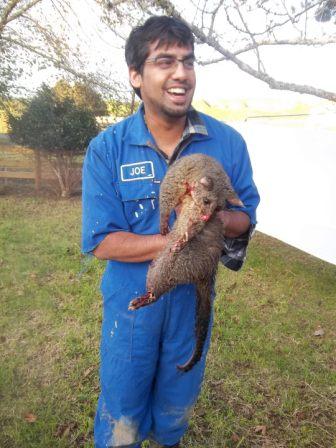
Then we caught a possum - so far at a rate of 1 per week
And then we plucked it ...

Mustering in the 2-tooths for their 5 in 1 vaccination before set stocking for lambing
 Our main project for the week was to start planting up the garden with natives.  Below are the before and after shots and there is still more plants to go.  Their help was greatly appreciated.
 
 
Before


Before


After

After
And the chook lady ...

 
 So, if keen to help out check out Help Exchange (http://www.helpx.net/) or contact us directly.  We will be seeking some extra help for docking in September.


Thursday, 27 June 2013

Thistles galore

With the drought leaving open pastures and the days being warm (till just recently), it has been optune thistle growing environment.  Our troublesome thistles include nodding, scotch and california predominantly.

We have a policy here to spray (when able) in the winter when the thistle plants are small on a biennial basis.  We do this with a helicopter  (http://www.heliworxwaikato.co.nz/index.html) and today happens to be that day. 

This mornings regime consisted of a stroll outside before 5am to see if there is any wind and await the pilots call at 5am.  This morning there was no breeze about the house so set the wheels in motion.  Then at 6am, another call from the pilot to check the tops, so off I headed decked out in warm clothing to the top yards on the ATV where a slight SE wind was detected, but we decided to give it a go.

7am the ground crew arrived, whilst the pilot had to wait for daylight to set off and arrived just after 7.30am.  First off we got to have a joy-ride, which is hardly that for someone who doesn't like heights.  With map in hand, we flew around all the main thistle areas targeting stock access ways, key grazing areas with high thistle populations.  I took my camera but was so encrossed in the blocks and pointing out the key areas that for a large part I forgot to use it!

Back at paddock site, the chopper was filled, and set off for his spraying run (8 ha at a time). We had completed 32 ha when the wind started to get up, so we temporarily called it quits. Managed a second flight up with a focus on taking more photos and Mal got to come this time, whilst the tanks were washed. 

Heliworx filling up with first load
Heliworx chopper heading off with first load
View from Woodleigh Road north
View from back country looking south-east


Te Herehere Falls
 The thistle germinates in autumn and forms a rosette during winter, which bodes well for a plant to produce flowers (which we don't want).  The open pastures formed by the drought are key areas for the thistle to make themselves at home, with nodding thistles germinating within the two months after a drought (which broke mid-April, meaning most should have germinated by now).  Therefore, spraying after the drought should have an economic benefit.

The reason we focus on removing the key thistle patches is that when thick, especially in key grazing areas they can reduce the growth rate of stock by the lack of pasture able to be consumed and in some instances can cause scabby mouth.  The other main reason is for stock movement which can be limited especially around tracks and gateways.

Spraying now when the thistle plants are small, also coincides with clover not being active, causing less damage.

If you want further information on weeds, check out the PestWebNZ (http://www.pestweb.co.nz/index.php). You can register to get regular updates. 


Tuesday, 11 June 2013

Post Drought Management

Just thought it was worth sharing some information that we found useful coming out of the drought. 

It was unfortunate really that this information was not available through NZ websites and industry and that we had to access this information from an Australian site.  Much of the information written up during and at the end of the drought was written largely around dairy farming, although some principles have parallels in both drystock and dairy.

Beef + Lamb NZ does offer the Dry Management Toolkit, which by in large talks about what is happening during the drought with little content about 'after' the drought. 

Factors that are talked about are:
  • Stress - the need to talk about the situation with those close to you and also outsiders and to get off farm to realise that you are not alone and others are suffering too.  One of the most frustrating and upsetting thing for a farmer is the inability to feed their stock.  Most of us are farmers because we enjoy working outdoors and with animals, with that in mind and the fact that the animals are the source of our income, it can become quite distressing. 
  • Making decisions early - having information and planning is key in a drought year, knowing what your feed profile is, what supplement you need and what stock need to go so that you can survive is key to the farming operation.  There are many operations with good records and information, but there are many without, and sitting and hoping and praying in a bad year will not pay dividends.
  • Financial Support - whilst the government declared a drought in many areas of NZ this year, it does not relate to direct financial assistance.  It does provide assistance through the Rural Support and consultant support if required.   Most of the subsidies available do not 'fit' the new farming families, therefore these are not taken up readily.  This year, the IRD has allowed a review of the Income Equalisation account to assist farmers that had profits last year and are looking at losses this year.
  • Feeding - the need to maintain intakes during the drought as much as possible, and following immediate rain to continue to do this to allow covers to grow and to give the plant a chance to grow.  There is plenty of information around feed allowances and different types of feed available and at what rates.
  • Animal Health - there is some discussion around animal health, in relation to feed intake, worms etc but felt there was less specifics about some of the things to look out for.
The types of information that were lacking in NZ publications was the emphasis and understanding of what happens when the drought has broken and how vulnerable stock can be especially if they are under condition and the wet brings cold as well.  Animals will generally have a lower immunity, especially if under conditioned.  They will have to adjust to changing feed whether it be supplement or changes in the pasture itself and they may be suffering from vitamin and/or mineral deficiences.

Following the drought period, whilst grass growth has been pneominal this year, there has been low  nutrient and high moisture levels in the pastures and many animals have suffered.  Stock at this time exert more energy to get a mouthful and can loose weight.  Some things to watch for include:
  • nitrate poisoning - fast growing plants, especially in an overcast environment will have a build up of nitrate levels and if hungry animals are moved they can gorge themselves, which can lead to nitrate poisoning.
  • handling stock in poor condition can put stress on their systems and can collapse or even die.
  • metabolic diseases in pregnant animals.
  • increased access to poisonous plants that might seem appealing to hungry animals.
Things that you can do:
  • make sure the animals are up to date with all their animal health treatments for both internal and external parasites.
  • ensure additional vitamins and minerals are given if necessary (may be an idea to take bloods and/or samples at works) to ensure what these levels are.
  • provide alternative feed and be prepared for stock to loose weight as they adjust to any new feed, including the new pastures post drought.
It is possibly too late now for this drought, but there are still some things for us to work on.  With cull ewes off to the works this week, we will be evaluating bloods to make sure all are acceptable.  All the animals have been on a higher than usual anthelmentic programme with the increase in worm population, especially Barbers Pole.  Most of our stock, whilst in good condition early April, lost condition following the rain for a 2 - 4 week period as the pastures have grown and the stock have adjusted to the change.

Saturday, 8 June 2013

Scanning Update

A wet Sunday afternoon, a quick update on our sheep scanning that we did on 29th May.  We managed to get all our sheep shorn, thanks to the covered yards (now a year old!).  We did things a bit different this year, shearing Mixed Age (MA) and 2-tooths from the home block first on 21 - 22nd May and then shore the Terminals from the other block on 26th May.  Shearing went without a hitch, except for the ability to get the wool out of the shed.  With two bikes and two trailers, shifting 4 bales at a time, we managed to load out the 22 bales with relative ease.

Things certainly turned in May, from the dry in the proceeding months (157 mls Jan - March) to 145 mmls in April and 280 mls in May (110 mls more than we had in any other May in the last 5 years).  Another 40mls to add to the June rain chart things are starting to get soggey underfoot.

29th May we scanned all the ewes in one day rather than two separate days as we had done in the past.  The general wider talk is that scanning percentages will be back based on the drought experienced.  We were grateful that our scanning faired well, with the Terminals and MA ewes scanning the same as last year and our 2-tooths were up 18%. 

Taratahi Students and others helping out at scanning
The ewes got a dose of Cypercare as they went up the race.

The ewes were in good condition going into tupping at around 64kg and 3.5 BCS, only a tad back on previous years.  During tupping they largely held condition through the two and half cycles to 12th April when the rams came out.  The drought broke mid-April and with the rapid growth of the pastures, stock have struggled since then, so at scanning some of the ewes were back on condition. 

We have taken the skinny 2-tooths, with a focus on the twinners and treating them a bit better.  We have added grain to their diet to boost them along.  Not always an easy  thing to get sheep initially interested to grain and as a result we have lost 2 sheep, out of 200.  And to keep numbers up in our terminals we have taken some MA singles down to the terminal mob.

Twin bearing 2-tooth ewes eating barley out of the feeder and hay off the ground following scanning.
So why were the 2-tooths up?  It wasn't to do with their condition, as on the whole they were probably lighter than last year as we had a higher number in lamb as hoggets last year.  We did put teaser rams out for the first time, as we had high dries last year.  So pleasing that we dropped that from 7% to 3%.

Whilst grass has grown, feed on the farm is still tight.  Currently in the process of getting rid of the last of our lambs, before sorting out all  of the cattle before hunkering down for the winter, which so far has been wet and mild.

Sunday, 5 May 2013

Our tank overflowith ... finally!

It was with pleasure that we finally watched out house tank overflow during heavy rain.  For April we received 145.5 mls, enough to kick the grass off.  It's turned the grass green and visually things don't look bad. 

The consequence is that the grass is not high in DM and although it might look good, there is no guts in the grass and they munch through quickly what is given to them.  So whilst we had good animal weights at the begining of April, we have struggled to maintain them through to the end of April, after the rain.  Our farm pasture cover as at 30th April was fairly tight at 1450 kgDM/ha, but reassuringly we have had less before.  To get through though we have used more silage, been fed out to all the dairy stock.  Updating Farmax, things will be tight and it will be a case of selling off stock and prioritising mobs around blocks as pasture allows.

The rain is currently continuing, with 16 mls yesterday, mainly arriving after 5pm.  More rain today from lunchtime onwards.  After having all this dry weather, you suddenly have all these tasks which would be so much better to do in the dry rather than the wet. 

Last week was focused on weighing and transferring dairy weaners and R2s.  All mobs weighed, R2s trucked home and a new mob of R1s arrived.  Our weights are back about 10 - 15 kgs on our targets, depending on mobs.  All the mobs are now settling down into their winter rotations to allow some pasture growth to create a feed wedge whilst the soil temps still remain warm.

Facial Ezcema still being high at 50,000 on home block and 30,000 on other block.  All R1 heifers are still protected by a Time Capsule through to 20th May.  We seem to be higher than other blocks sampled through our vets in the Northern Waikato area.

Our focus has been a little on repairs and maintenance - repairing some of our fences in our back sheep country, blocking goat holes, replacing flood gates, replacing staples and any broken wires.  On our other block, focus has been on tracks and crossings, making sure that we can access main parts of the farm safely and filling up gateways. 

At the end of the month we look forward to shearing and scanning.  When taking the rams out of the ewes, the ewe condition seems to have been maintained through tupping, so fingers crossed that scanning results will be positive.

Wednesday, 3 April 2013

It was a pleasure to get wet this morning!

It was a pleasure to get wet this morning but it seems that our rain was short lived.  We have been getting pretty dry, as has the rest of the North Island.  We were fairly late in being impacted by it with rough feed on board and the grass hanging in, but over the last couple of weeks things have certainly changed.  The base pasture in the hill paddocks has basically gone, cracks opened up, leaving only some pickings for the stock.

So far today we have had 15 mls.  Looking back at our rainfall records, it has been the driest quarters since we have been here:
  • Nov - Jan 172 mls v's 304 average (56% rainfall)
  • Dec - Feb 245 mls v's 344 average (71% rainfall)
  • Jan - Mar 157 mls v's 295 average (53% rainfall)
On Sunday we drove from Auckland to home in the rain, but the rain and the puddles stopped one valley before home.  So whilst Auckland had 15 mls, Onewhero 10 mls, we had none.

We have been feeding out since the beginning of March, and based on our feed budgets, would expect us to continue this into May.  Our target priority mobs to feed are our Dairy Grazers, getting silage, and the R2s getting poplar.  They are all due to be weighed this month.  Our Ewes went to the ram 1st March at condition score 3.5 across both maternal and terminal.  On the whole they seem to be holding their own.  The rams will come out next week.  Our beef cattle are fared ok with 0.4 kg/day.  They have been grazing the rough stuff and doing a bit of cleanup so hadn't expected any better than this.

Our lambs have struggled as quality feed as disappeared.  So far we have managed to meet all the contract targets but with the dressing out % being down, our carcass weights haven't been the best.  We are probably carrying a few too many lambs on and will need to shift them in the coming months.  Lambs will all be weighed on Saturday with a pick going out the following week.

Our focus now is to ensure key stock are holding or improving, with our beef cattle being the buffer.  Focus turns to giving the grass opportunity to grow.  The new grass paddocks are holding their own and bouncing back well after rain.  Key paddocks on both blocks have been targeted with lime at 1.5 t/ha via aircraft.   This was applied 2 days before we had rain in mid-March - perfect timing!

This time of year also brings challenges of FE, with all our dairy grazers given a Time Capsule and their 2nd capsule going in next week.  We do spore counts on each block on the dairy grazers rotation.  One block has been holding around 10,000, whilst the other has been sitting 40,000 +.  We are awaiting this weeks results.  We are not worried about the sheep as all sires purchased have high FE tolerance. 

It is that time of the year when budgets are reviewed through to end of June and for the following 2013/14 year.  Lamb prices have certainly played a hindrance in this years budget and we are back quite significantly.  Going forward, conservative prices have been adhered to in the budget - anything over and above is a bonus.  We are expecting a few less lambs as we are not mating the hoggets and keeping scanning/lambing figures realistic as not sure what the impact of the dry will be in the long run.  To counter that though, we have managed to get rid of all the 'old' ewes that were originally bought on the farm, and now all ewes on the place we have bred ourselves and have the potential to do better lambing percentages.

Fingers crossed we get a bit more rain ... ideally need at least 100 mls to make a difference and some warm days to get the grass growing.

Sunday, 17 February 2013

It's getting pretty dry

It's 2.30 pm, having just finished lunch and a coffee, with the hot day we are taking things slow for an hour or two.  The sun is beating down and parching our grass and soil.  The season has certainly turned the colour of the landscape a scorched brown.  With each passing truck, there is a wave of dust that floats over the front paddock.  Today there is bearly a breathe of wind, so plenty of birds and bees to be heard.

In my last blog I commented on it getting dry, a total of 39.5 mls for January.  The first Sunday in February I tipped out 39 mls, with another 24 mls the next day, but haven't had a drop since.  The creeks are certainly getting low, and it is getting harder to contain animals in their paddock as they start sneaking next door to see if the grass is greener.

Today, Mal mustered in the Terminal Ewes between 6 - 8 am, when stock are easier to shift in the cooler morning air.  With 10 days till the ram goes out, we gave them a pre-tup drench and conditioned scored them.  We separated off 200 of the lighter ewes to be lighter stocked over tupping and the better conditioned at a slightly higher rate.  The average condition score was 3.5, which considering the season isn't too bad.  The risk now, is them loosing weight with the ram going out.  It is pleasing to say, that of our 700 terminal ewes, all barr 50 of them we have bred over the first 5 years of being on farm.

We also collected any straggler ewe lambs - they have been drenched and age marked.

Tomorrow morning at 6am, we have 200 lambs heading off on the truck for a terminal trip.  We crutched what needed crutching yesterday, and hope they yeild well. 

We have started our spore counting on a weekly basis, with results back on a Wednesday.  Results so far:
Dixon Road, South Face = 0
Woodleigh Road North Face = 10,000
The first of the Time Capsule bullets have started to go into the heifers, and this will be our focus for the week to get the remainder in, to protect them from Facial Eczema.

We have had a French Canadian, Priscillia  here for the last week, and has helped out on farm, in the house, with Alice etc.  Will post some photos when I get more organised.  Amongst all the work we did manage a half day break to Raglan yesterday.